In the previous four episodes, we discussed how guests find you, how well your website sells, how Google “reads” it, and how comfortable the booking process is on mobile devices.
Now it’s time to ask perhaps the most important question:
How do you know what works and what doesn’t?
Because if you can’t measure, you can’t improve. And if you can’t improve, a competitor will inevitably overtake you.
The Number That Explains Everything
According to industry data (SearchAtlas, 2026), 82% of hotels use Google Analytics 4 (GA4), yet only 23% of them have properly configured e-commerce and conversion goals.
This means 77% of hotels are collecting analytics, but not actually reading them. They can see that visitors come to the site, but have no idea where they come from, where they stop, why they leave, or why the booking isn’t completed.

5 Reasons Analytics Fails — Where Value Is Lost
1 — GA4 Is Simply Installed, Not Configured
Installing GA4 doesn’t mean analytics is working correctly. The system needs properly defined Events, for example: clicking the Book Now button, viewing a specific room page, starting the booking process, and completing a booking successfully. Without this, GA4 only counts visitors but will never tell you at which stage you’re losing potential guests.
2 — The Booking Engine Doesn’t “Talk” to GA4
This is one of the most common technical problems in the hospitality industry (The Lobby, 2026). If your Booking Engine operates on a separate domain and Cross-domain Tracking isn’t properly configured, the user session breaks. As a result, GA4 can no longer see the guest’s complete journey — from the website to booking completion. Traffic source is often simply recorded as Direct / None.
3 — Marketing Campaigns Without UTM Parameters
Without UTM parameters on your links, GA4 can’t distinguish whether a guest came from a Facebook post, Google Ads, an email campaign, or another source. Research shows that properly using UTM parameters increases marketing budget efficiency by 30–40%.
4 — High Bounce Rate, But You Don’t Know Why
Bounce Rate shows how quickly users leave the website. If this metric is high, the problem could be in load speed, content quality, mobile version, or the booking process. But identifying it is only possible with properly set up Tracking. (TravelBoom, 2025)
5 — Watching the Wrong Metrics
A manager shouldn’t ask: “How many visitors did we have?” The right question is: “Which channel brought us the most bookings and revenue?” Without the Acquisition Report, you could be spending your entire budget on a channel that brings lots of visitors but almost no real bookings. (Digisap, 2026)
Analytics = Financial Visibility
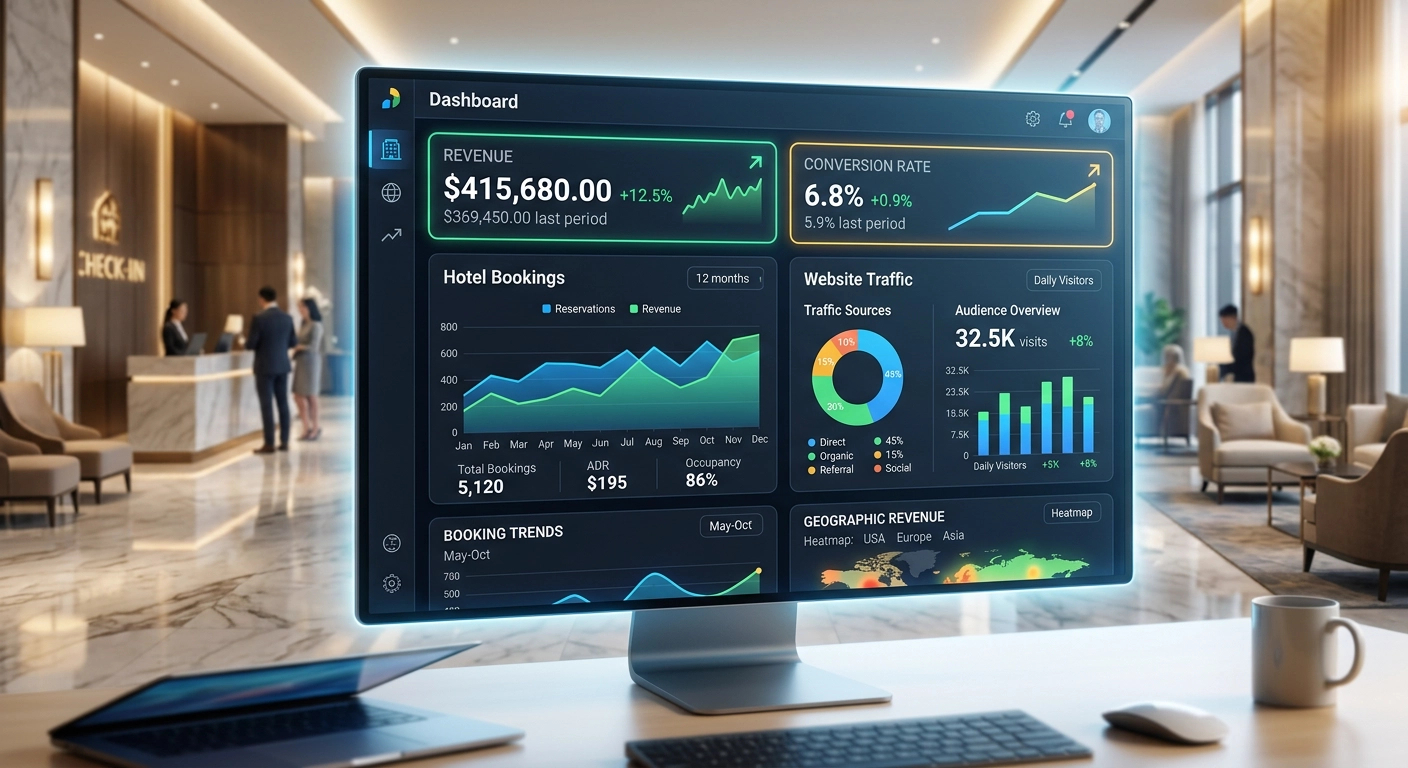
Properly configured analytics will tell you exactly: which Google search keyword leads a guest to a booking; which campaign gives you the best return (ROAS); at which stage guests abandon the booking process; and what the difference is between mobile and desktop conversion. When you have answers to these questions, marketing is no longer a cost — it becomes a measurable investment.
💡 HIT Hub Observation:
Most Georgian hotels, wineries, and restaurants do indeed have GA4 installed. But “installed” and “properly configured” are completely different things.
In practice, we frequently see that the Booking Engine is completely disconnected from GA4, and in the traffic sources, only Direct / None is recorded. The business spends thousands on advertising, gets visitors, but cannot measure which channel actually generates revenue.
Often the problem is neither the advertising nor the budget. The problem is that the business cannot see its own data. And a business that cannot see what works turns investment into mere expenditure.
Before another season passes “blindly,” check how accurately your website measures the user journey and where the booking opportunity disappears.
Sources: SearchAtlas 2026 · The Lobby 2026 · TravelBoom 2025 · Digisap 2026